Web Analytics

Vinalchemy vs conventional micro-oxygenation

From Prediction to Production Certainty

Vinalchemy is not faster MOX. It gives the winemaker a fundamentally different way to develop wine: create the result, taste it immediately, approve it, then reproduce it in production.

01

The difference in one sentence.

This is not simply a faster way to perform MOX. It is a fundamentally different way to control wine development.

Conventional micro-oxygenation manages oxygen exposure and waits for the wine to develop. Vinalchemy allows the winemaker to create, taste and approve the required final organoleptic outcome immediately—then reproduce that exact outcome at production scale.

The conventional decision
WITH MOX, THE WINEMAKER PREDICTS THE RESULT.
The Vinalchemy decision
WITH VINALCHEMY, THE WINEMAKER TASTES AND APPROVES IT.

With conventional MOX, oxygen is introduced slowly over weeks or months. The winemaker monitors the wine, tastes it repeatedly and adjusts the programme while predicting how it may eventually develop.

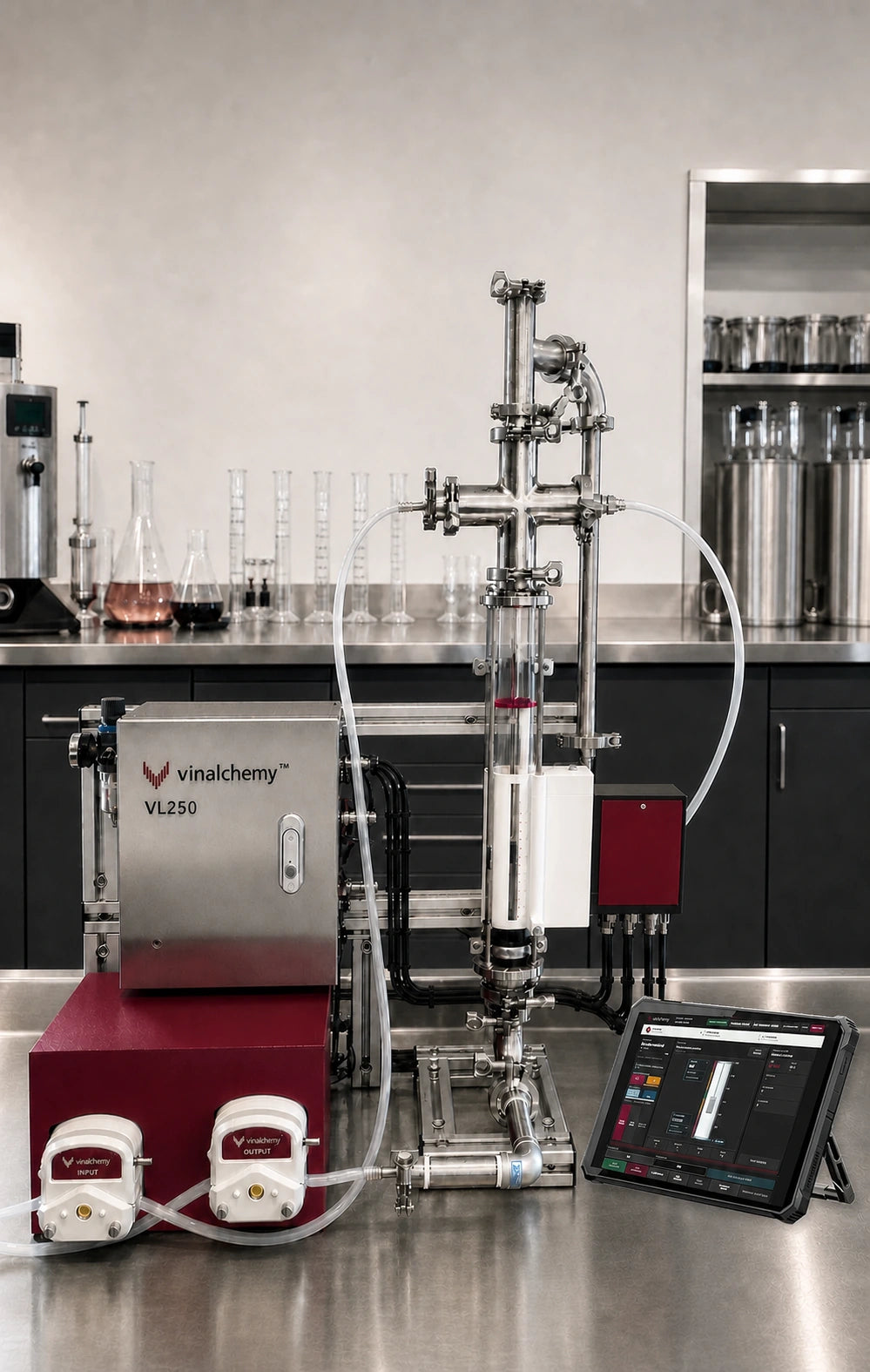
With Vinalchemy, the winemaker works directly with the actual wine on the VL250. The treatment can be adjusted and sampled immediately. Once the required taste, aroma, colour, integration and structural profile have been achieved, those exact treatment parameters are transferred to the V6000 for production.

The decision is made before the production batch is committed.

02

Why dissolved oxygen is not the outcome.

Dissolved oxygen helps manage conventional MOX. It does not tell the winemaker whether the wine tastes right.

Dissolved oxygen measurement can indicate whether oxygen is accumulating and whether a prolonged MOX programme appears to be progressing within its operating guidance.

It does not define the desired aroma, texture, colour, tannin integration or drinking profile. Those decisions are still made through the winemaker’s nose and palate, supported where appropriate by laboratory analysis.

In conventional MOX, dissolved oxygen is therefore a guide to a process whose final sensory result becomes apparent only after the programme has run its course.

How Vinalchemy works

The Vinalchemy treatment process

Wine flows continuously through Vinalchemy’s patented gas-reaction system. The treatment result can be tasted as soon as the wine leaves the system.

01 · Wine enters VinalchemyWine flows into the treatment system02 · Carrier gas entersA low-oxygen nitrogen carrier meets the wine03 · Vinalchemy reaction zoneFine bubbles create rapid gas-to-wine contact04 · Reaction and removalOxygen reacts immediately; nitrogen strips unreacted oxygen05 · Immediate resultTreated wine leaves Vinalchemy ready to taste

Vinalchemy does not attempt to infer the final wine profile from a dissolved-oxygen reading. It lets the winemaker taste the result itself.

03

A fundamentally different development process.

MOX manages a moving target. Vinalchemy moves the decisive winemaking judgement to the beginning.

Conventional MOX

The wine changes while the programme runs.

A conventional MOX programme introduces very small quantities of oxygen over days, weeks or months. The wine is tasted and tested repeatedly while its chemical and structural reactions continue to develop.

A slow trial cannot operate as a time-neutral recipe for the live production wine. By the time the trial reaches its endpoint, the untreated wine awaiting the decision has also moved on chemically and structurally.

Increasing the oxygen dose does not solve the problem. MOX is constrained by the wine’s oxygen-consumption capacity. Trying to compress the programme risks oxygen accumulation, over-oxidation and irreversible damage.

Vinalchemy

The result is known before production begins.

The winemaker treats the actual wine on the VL250 and tastes the result immediately. The treatment can be adjusted and the wine sampled again until the required profile is achieved.

The winemaker can decide how soft, integrated, aromatic, structured or developed the wine should be—including profiles traditionally associated with 12, 18 or 24 months of maturation.

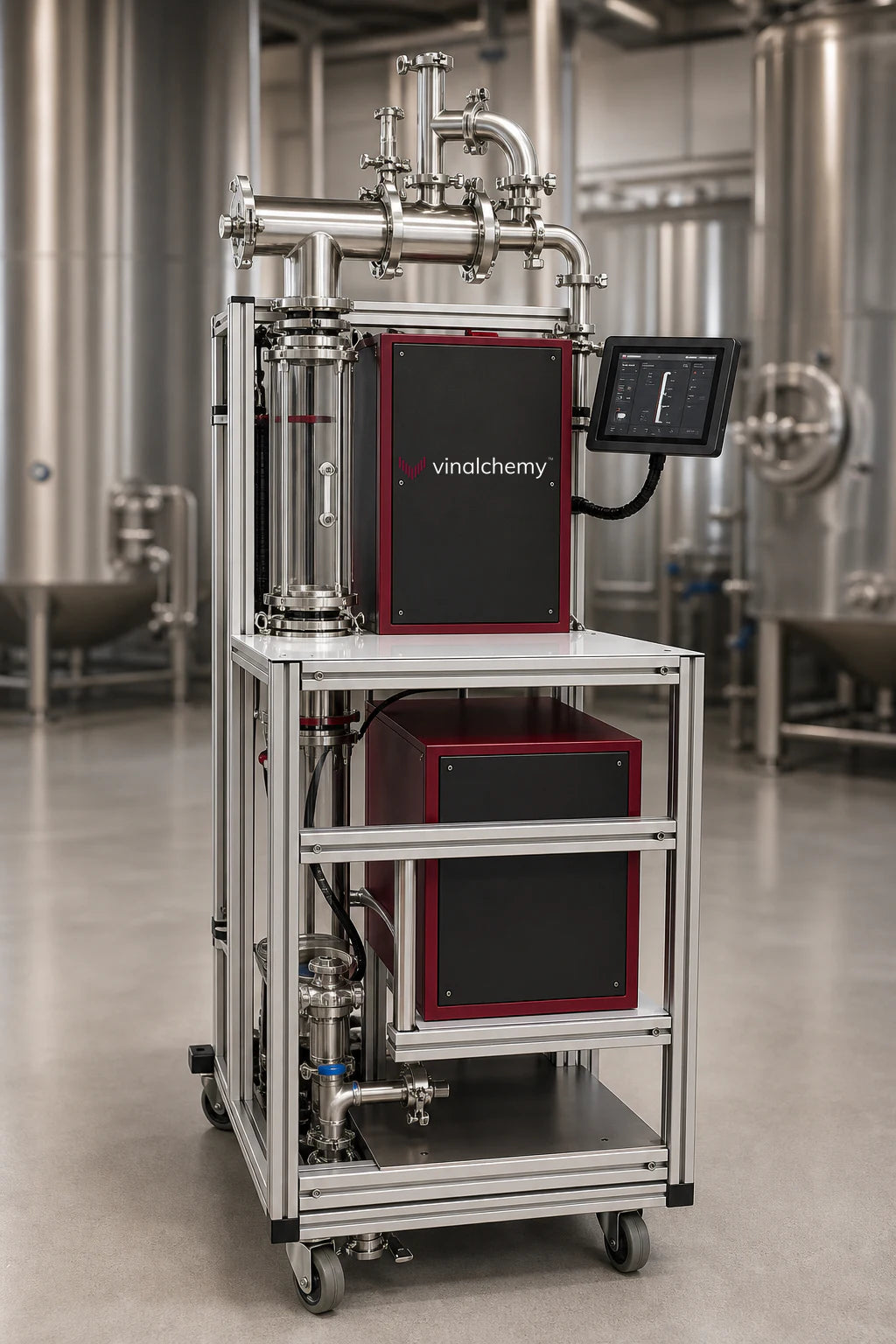
Once satisfied, the exact approved treatment parameters are transferred to the V6000. This is not a new prediction at scale. It is production of a result that has already been tasted and approved.

Conventional micro-oxygenation compared with the Vinalchemy treat, taste, approve and reproduce workflow
Conventional MOX manages development over time. Vinalchemy creates and approves the required outcome before production.
Vinalchemy VL250 wine development system
DevelopmentThe VL250 creates the result.

Treat the actual wine. Taste immediately. Adjust and sample again.

Exact approved parameters
Vinalchemy V6000 wine production system
ProductionThe V6000 reproduces it.

The system runs autonomously while the operator can monitor and intervene at any time.

The treatment outcome is immediate. The wine continues its normal life and evolution afterwards, but the organoleptic objective of the treatment is already present.

04

Side-by-side comparison.

The distinction is not about whether a MOX controller is modern or precise. It is about the underlying operating and decision model.

Conventional micro-oxygenation compared with Vinalchemy.
Decision areaConventional MOXVinalchemy
Basic approachSlow oxygen addition to wine held in a tankControlled gas-reaction treatment of flowing wine
Treatment periodDays, weeks or monthsImmediate treatment outcome
Gas processOxygen dosing through a tank diffuserLow-O₂ nitrogen carrier in a patented reaction zone
Oxygen behaviourDosed below the wine’s consumption rate over timeDissolves and reacts immediately; nitrogen strips residual unreacted oxygen
Role of dissolved O₂Process guide for oxygen remaining or accumulatingNot the determining endpoint
Primary decisionRepeated taste, colour and laboratory review during the programmeImmediate taste, aroma and colour assessment of treated wine
When the result is clearAt or near the end of the programmeAs wine leaves the VL250
Trial relevanceProduction wine continues changing while a slow trial runsActual wine is treated and assessed immediately
Ability to adjustAdjust, then wait for further developmentAdjust, sample and taste again immediately
Scale-upApply a programme in expectation of a future resultTransfer the exact approved VL250 treatment parameters to the V6000
Production resultEmerges progressivelyReproduces the approved treatment result
Wine phasesEarliest phase is difficult and often avoidedPractical across wine phases, including the early opportunity
Wine stylesUsed predominantly for red winesApplicable to red, white, rosé, sparkling and fortified wines
Winemaker’s positionMonitors a prediction as it developsSelects and approves the result before production
05

Why choose Vinalchemy.

The purchasing case begins with certainty in the wine. Its operational and commercial effects follow from that change.

01

Taste the result before committing the batch.

The winemaker evaluates the actual treatment response before the production wine is committed. This replaces a prolonged prediction with an immediate, sensory-approved decision.

02

Develop wine profiles in real time.

Treat the actual wine, taste immediately, adjust, sample again, compare alternative profiles, select the preferred outcome and approve the exact treatment parameters.

03

Reproduce the approved result at production scale.

The V6000 is not a separate interpretation of the VL250 trial. It uses the exact approved treatment parameters to reproduce the selected result.

04

Reduce prolonged specialist intervention.

Conventional MOX requires repeated tasting and interpretation over an extended period. Vinalchemy simplifies the decision: treat, taste, adjust, approve and produce.

05

Work confidently across wine phases and styles.

Vinalchemy can be used across red, white, rosé, sparkling and fortified wines—including the early phase in which oxygen can have its greatest positive influence.

06

Release commercial value sooner.

Earlier product readiness, faster decisions, reduced treatment-related tank occupation, better use of winery capacity and less capital tied up while waiting for an endpoint.

06

More saleable wine. Stronger economics.

Vinalchemy can change how much of a harvest becomes saleable, how long winery assets remain occupied and how soon capital returns to the business.

Recover more saleable wine from the same harvest.

Many premium wineries limit saleable utilisation to approximately 60% because later hard-press fractions and wine recovered from heavy lees can carry bitter phenolics and harsher tannins.

Vinalchemy lets the winemaker separate these fractions, trial the actual wine on the VL250 and approve the sensory outcome before production. The recovered wine can increase first-wine volume or support commercially viable second and third wines.

60% → 80%Route created by using the full hard pressapproximately 33% more yield from the same harvest
Up to 95%With suitable separate lees-recovery equipmentapproximately 60% more saleable yield compared with a 60% base

Approved V2.2 winery-scale examples

Still wine

18 → 4 months modelled stockholding
Recurring annual modelled contribution uplift
c.£27,000
Separate one-off modelled working-capital release
c.£59,000

Sparkling wine

38 → 20 months modelled stockholding
Indicative annual commercial benefit
c.£59,000
Separate one-off modelled working-capital release
c.£105,000

Working-capital release is a one-off first-cycle effect; it is not added to the annual figure. Both examples model 56,700 bottles per year, 50% of production treated and an unchanged selling price. They are separate illustrative scenarios, not forecasts, and must be localised using the winery’s own inputs.

07

The competitor market is technically capable. The category difference is still unmistakable.

Established systems can offer precision, connectivity, automation, recipes, records, multiple tanks and sensor data. Those features improve MOX. They do not remove its fundamental limitation: time.

Competitors improve the management of oxygen addition over time. Vinalchemy lets the winemaker select the finished treatment result first and then produce it.

Parsec

SAEn4000; SAEn5000 + Quadr@; MOXEasy

Public offer. Constant-volume micro-, macro- and single-dose control; compensation; cellar automation; traceability and decision support.

Strength. One of the strongest conventional combinations of metrology, automation and oenological guidance.

Vinalchemy difference. Parsec can make a MOX programme better controlled, but the result still emerges over time. It does not reveal the final organoleptic endpoint when the programme is selected.

Official product information (opens in a new tab)

Vivelys

Visio S, Visio and Grand Visio; Scalya automation

Public offer. Guided continuous micro- and macro-oxygenation, from individual tanks to large central installations with up to 96 outputs.

Strength. Category authority, mature methodology, extensive scalability and strong oenological support.

Vinalchemy difference. Vivelys manages tank-resident programmes extremely well. The full tank still evolves over time and the winemaker must wait to judge the ultimate sensory result.

Official product information (opens in a new tab)

Agrovin

DosiOx and Electrowine

Public offer. PLC-controlled oxygen dosing, diagnostics, records, remote operation and wine-side oxidation-reduction-potential trending.

Strength. Strong automation and one of the clearest wine-side sensor propositions.

Vinalchemy difference. Agrovin’s ORP and dissolved-oxygen readings help the winemaker monitor an oxygenation programme. They do not show whether the wine has reached the desired taste, aroma, colour or structure. With Vinalchemy, the winemaker tastes the treated wine immediately, adjusts the treatment if required, and approves the result before production.

Official product information (opens in a new tab)

Enartis

MicroOx and WIN-IQ OX

Public offer. Flow and pressure control, self-diagnosis, broad tank ranges, network connection, remote access and downloadable records.

Strength. Familiar tank retrofit, established distribution and credible operation across large tanks.

Vinalchemy difference. Enartis offers a capable way to dose oxygen into tanks. Vinalchemy creates the approved result before the production run begins.

Official product information (opens in a new tab)

AEB Engineering

Microsafe O₂

Public offer. Micro-, macro- and single-dose modes; pressure and temperature sensing; protective suspension and multi-tank configurations.

Strength. Safety controls and conventional retrofit familiarity from a recognised international supplier.

Vinalchemy difference. AEB improves safe oxygen dosing. Vinalchemy changes where the treatment occurs, when the result is known and how a selected trial outcome becomes production.

Official product information (opens in a new tab)

VinPilot

VinPilot® Oxy; optional VinPilot® Brix integration

Public offer. A decentralised dosing unit per tank, central recipe and record management, temperature windows and optional fermentation-stage control using Brix.

Strength. Credible automation, modularity and stage-based fermentation control.

Vinalchemy difference. Brix identifies fermentation progress, not the final sensory endpoint. VinPilot remains one oxygen programme per tank; Vinalchemy is a development-to-production treatment platform.

Official product information (opens in a new tab)

Oenofrance / Martin Vialatte

OENO2

Public offer. Electronic mass-flow and pressure control, 1- or 2-outlet units and central systems with 5, 10, 20 or 30 outlets, touchscreen operation and diagnostics.

Strength. Flexible, precise multi-output MOX supported by an established oenological supplier.

Vinalchemy difference. Precision oxygen supply does not remove the waiting period or make gas delivery a sensory result. Vinalchemy lets the winery approve the wine before production.

Official product information (opens in a new tab)

Research note. Competitor descriptions summarise manufacturers’ public information reviewed on 2 September 2026. Capabilities and configurations should be confirmed with each manufacturer. Product names and trademarks belong to their respective owners; no affiliation or endorsement is implied.

08

Why wineries with MOX already installed should change.

Owning a MOX system does not remove the limitations of MOX.

Why continue waiting weeks or months to discover a result that Vinalchemy lets the winemaker create and approve now?

The installed system still manages uncertainty

Automation does not change the endpoint problem.

A connected MOX controller can follow a sophisticated schedule perfectly while the winery still waits to discover how the wine will ultimately taste.

  • Delay before the final outcome becomes known
  • Repeated tasting, laboratory work and monitoring
  • A slow trial on wine that continues to evolve
  • Dependence on experienced MOX operators
  • No safe shortcut through a sharply increased dose

The investment decision should look forward

The existing equipment price is a historical cost.

The future decision should compare operating cost from today: treatment-related tank-days, saleable yield, energy, storage, handling, operator time, the point of approval, speed to the intended profile, recurring contribution and separate first-cycle working-capital release.

An installed MOX system proves that the winery can dose oxygen into tanks. It does not create the full Vinalchemy opportunity.

09

A practical transition.

The strongest case for changing is not a theoretical presentation. It is allowing the winemaker to taste the Vinalchemy result.

  1. 01

    Select a suitable wine currently being considered for MOX.

  2. 02

    Run development samples through the VL250.

  3. 03

    Let the winemaking team taste and compare the immediate results.

  4. 04

    Select and approve the preferred result.

  5. 05

    Transfer the exact approved parameters and reproduce the result on the V6000.

  6. 06

    Compare time, intervention, tank use, saleable yield, energy, storage, financing and commercial result.

  7. 07

    Move suitable future treatments to Vinalchemy.

10

Independent proof. Commercial application.

The immediate final organoleptic outcome has been demonstrated at Plumpton and supported by a wider programme across wine types and vintages.

36
wines tested in triplicate against controlsPlumpton report dated 6 January 2026
108
bottles assessed across treated and control samples36 wines tested in triplicate
p < 0.05
reported statistical thresholdabove the conventional 95% confidence threshold
13 / 15
participants in one small tasting preferred sparkling wine made from treated base winesample-specific sensory observation
≈9,000L/day
standard V6000 production capacitybespoke systems available up to 40,000 L/day

Plumpton assessed 36 wines in triplicate—108 bottles in total—using treated and control samples. Across its two ANOVA summaries, the report identifies statistically significant treatment-control differences at p < 0.05, above the conventional 95% confidence threshold, in pH, tartaric acid, colour density and phenolic content. The report alternates between pH and tartaric acid as the stated acidity measure and does not reproduce the full ANOVA table.

Separately, 13 of 15 participants in one small sparkling-wine tasting preferred wine made from Vinalchemy-treated base wine. This is a sample-specific sensory observation, not a universal preference claim.

11

Common questions.

Direct answers to the objections that arise when Vinalchemy is mistaken for another MOX system.

We already have a MOX system. Why should we consider Vinalchemy?

A MOX system can still dose oxygen slowly. It cannot show the winemaker the final organoleptic outcome immediately or transfer exact approved VL250 treatment parameters directly into V6000 production.

Is Vinalchemy simply faster micro-oxygenation?

No. Vinalchemy is not conventional MOX operated at a higher oxygen dose. Its patented low-oxygen nitrogen-carrier gas-reaction process works differently.

Why is dissolved oxygen not the treatment endpoint?

Dissolved oxygen helps manage conventional MOX, but it is not the wine style and it is not the final sensory outcome. Taste, aroma, colour and structure—not a dissolved-oxygen number—determine whether the wine is right.

How does Vinalchemy move from trial to production?

The winemaker develops and approves the result on the VL250. The exact approved treatment parameters are transferred to the V6000, which reproduces the selected outcome at production scale.

Can a small MOX trial provide the same certainty?

A slow MOX trial cannot freeze the production wine in time. While the trial develops, the untreated production wine also changes. Vinalchemy reveals the actual wine’s response immediately.

Could the wine be overtreated?

Immediate sampling, small development volumes, low-oxygen blends and fine control make Vinalchemy extremely resistant to overtreatment. The winemaker sees and approves the response before production.

Does Vinalchemy remove the need for laboratory testing?

No. Laboratory analysis remains available wherever the winemaking team considers it useful. It supports the immediate sensory decision rather than standing in for an outcome that will only become clear later.

Can Vinalchemy improve saleable yield?

The winemaker can trial harder press and separated-lees fractions on the VL250, taste the treated result and approve only the wine that meets the required standard. Full hard-press recovery creates a route from approximately 60% to approximately 80% utilisation, with further opportunity where suitable lees-recovery equipment is used.

The Vinalchemy proposition

Conventional MOX helped wineries move beyond passive maturation. Vinalchemy moves the industry beyond prolonged oxygen prediction.

It gives the winemaker something MOX cannot provide: the ability to create the intended profile, taste it immediately and approve it before committing the production batch.

The VL250 creates the result. The winemaker approves it. The V6000 reproduces it. Vinalchemy: certainty over hope.